

tuesday 10.11. 18h
Ana Devic & Lada Furlan Zaborac
Spying on Medea
performance
tuesday 10.11.
18h
performance
Ana Devic & Lada Furlan Zaborac
Spying on Medea

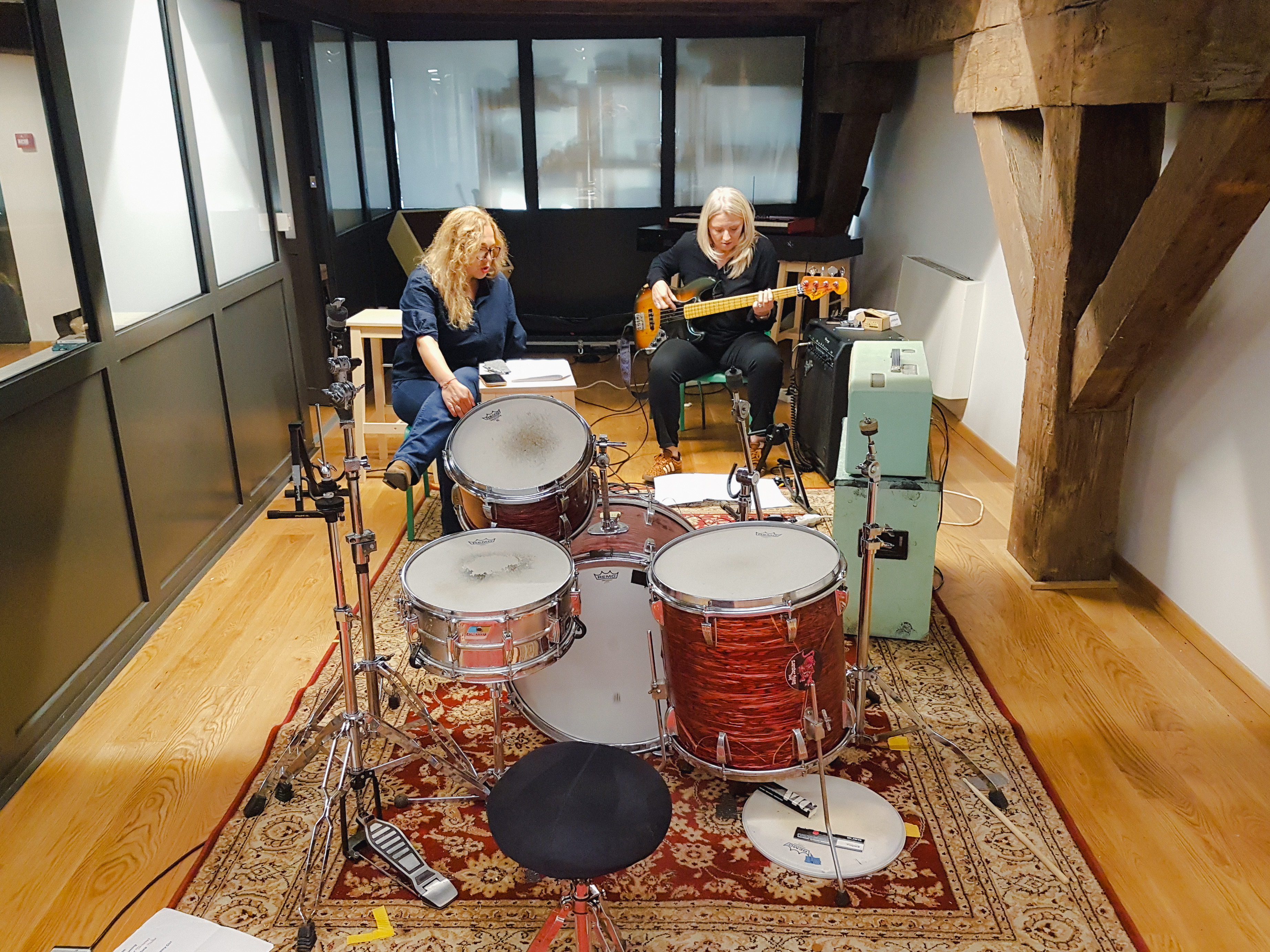
In a space of joint performance, the collaboration between poet Ana Dević and musician Lada Furlan Zaborac intertwines speech and sound, poetry and music. Two equal voices and positions create a space of mutual dialogue.

We encounter Medea in the streets of the afterworld as an end-times figure with many faces. She is a stranger wandering the city streets, a marginalised woman, am enchantress and a healer, stepping out of retirement to work precariously and seeing what we miss.
The end of the world doesn’t happen suddenly; rather, it becomes a permanent state in which personal disasters meet the world crises. Testing the boundary of what can(not) be said, here we observe Medea as an archetype of the female experience: aging, invisibility, all those quiet and big personal losses – love, body and one’s place in a world falling apart.
Moving her away from the image of an avengeress, Spying on Medea observes her as a figure of survival: from an unspeakable mother Medea becomes a sister of the apocalypse we keep encountering. Where her story is already proclaimed finished, she continues to speak.

And then
Medea and I meet briefly
in the Dubravica bakery
while I'm ordering
a buckwheat salad.
She's wearing glasses
struggling to find the code
since she's new to the job
Is she working in retirement?

I say
take it easy
Easy doesn’t cut it in capitalism
says Medea.

Ana Dević: Uhodeći Medeju, 2026.
Translation: Marina Veverec

Thank you: Sonja Pregrad, Marko Gutić Mižimakov, Tea Kantoci, Dora Brkarić, Romana Ilić, Urania, Zagreb, Jelena Miholjević, Monika Herceg, Nikolina Maletić, Marina Veverec, Gradska galerija Striegl/Holandska kuća, Sisak, Sanja Merćep

In a space of joint performance, the collaboration between poet Ana Dević and musician Lada Furlan Zaborac intertwines speech and sound, poetry and music. Two equal voices and positions create a space of mutual dialogue.

We encounter Medea in the streets of the afterworld as an end-times figure with many faces. She is a stranger wandering the city streets, a marginalised woman, am enchantress and a healer, stepping out of retirement to work precariously and seeing what we miss.
The end of the world doesn’t happen suddenly; rather, it becomes a permanent state in which personal disasters meet the world crises. Testing the boundary of what can(not) be said, here we observe Medea as an archetype of the female experience: aging, invisibility, all those quiet and big personal losses – love, body and one’s place in a world falling apart.
Moving her away from the image of an avengeress, Spying on Medea observes her as a figure of survival: from an unspeakable mother Medea becomes a sister of the apocalypse we keep encountering. Where her story is already proclaimed finished, she continues to speak.

And then
Medea and I meet briefly
in the Dubravica bakery
while I'm ordering
a buckwheat salad.
She's wearing glasses
struggling to find the code
since she's new to the job
Is she working in retirement?

I say
take it easy
Easy doesn’t cut it in capitalism
says Medea.

Ana Dević: Uhodeći Medeju, 2026.
Translation: Marina Veverec

Thank you: Sonja Pregrad, Marko Gutić Mižimakov, Tea Kantoci, Dora Brkarić, Romana Ilić, Urania, Zagreb, Jelena Miholjević, Monika Herceg, Nikolina Maletić, Marina Veverec, Gradska galerija Striegl/Holandska kuća, Sisak, Sanja Merćep

Ana Dević , curator, educator and writer, graduated in art history and comparative literature from the Faculty of Humanities and Social Sciences in Zagreb. Her work connects different fields that include hybrid forms of artistic production: exhibitions, publications and discursive formats. She is a member of the WHW collective with which she has co-curated numerous exhibitions, such as Collective Creativity, Kunsthalle Fridericianum, Kassel (2005); 11th Istanbul Biennial What Keeps Mankind Alive? (2009); Really Useful Knowledge, Reina Sofía, Madrid (2014), etc., and the program of the Nova Gallery (2003-2023). She is a PhD candidate in art history at the University of Zadar. She is one of the programme educators of the WHW Academy and a lecturer at the MA course of the Nuova Accademia di Belle Arti in Milan. In addition to writing texts in the field of art, she writes poetry and short prose. She published her first poetry collection, Devedeset devet doprinosa disanju, in 2024 (Meandar Media, Zagreb). She is part of the team of the 9th International Conference on degrowth, Planet, People Care: It Spells Degrowth and the curator of the exhibition of the same name, which took place in Zagreb in 2023. She lives and works in Zagreb. She dances and writes whenever she can.


Lada Furlan Zaborac , musician and translator, born in Sisak in 1976. She graduated from the Faculty of Humanities and Social Sciences in Zagreb in 2001 with a degree in Comparative Literature and English Language and Literature. She has worked in literary translation since 2000, initially as an associate for different shows for the Croatian Radio channel 3. She is the author of 25 translations of fiction and non-fiction titles published so far. A full member of the Croatian Literary Translators' Association. She has been professionally involved in music since 1994 as a bassist for the bands The Bambi Molesters (1994-2017), The Strange (2004-2017) and LHD (2017 to present). She is the winner of the Status Award from the Croatian Music Union in 2012. Since 2023, she has been participating in the Kin-o-zvuk project with her parent band LHD, composing the original film score for the digitally restored Croatian silent film Birtija (1929) and performing it during cinema screenings. She lives with her family in Sisak, where she works as an English teacher at the Sisak High School.

Ana Dević , curator, educator and writer, graduated in art history and comparative literature from the Faculty of Humanities and Social Sciences in Zagreb. Her work connects different fields that include hybrid forms of artistic production: exhibitions, publications and discursive formats. She is a member of the WHW collective with which she has co-curated numerous exhibitions, such as Collective Creativity, Kunsthalle Fridericianum, Kassel (2005); 11th Istanbul Biennial What Keeps Mankind Alive? (2009); Really Useful Knowledge, Reina Sofía, Madrid (2014), etc., and the program of the Nova Gallery (2003-2023). She is a PhD candidate in art history at the University of Zadar. She is one of the programme educators of the WHW Academy and a lecturer at the MA course of the Nuova Accademia di Belle Arti in Milan. In addition to writing texts in the field of art, she writes poetry and short prose. She published her first poetry collection, Devedeset devet doprinosa disanju, in 2024 (Meandar Media, Zagreb). She is part of the team of the 9th International Conference on degrowth, Planet, People Care: It Spells Degrowth and the curator of the exhibition of the same name, which took place in Zagreb in 2023. She lives and works in Zagreb. She dances and writes whenever she can.


Lada Furlan Zaborac , musician and translator, born in Sisak in 1976. She graduated from the Faculty of Humanities and Social Sciences in Zagreb in 2001 with a degree in Comparative Literature and English Language and Literature. She has worked in literary translation since 2000, initially as an associate for different shows for the Croatian Radio channel 3. She is the author of 25 translations of fiction and non-fiction titles published so far. A full member of the Croatian Literary Translators' Association. She has been professionally involved in music since 1994 as a bassist for the bands The Bambi Molesters (1994-2017), The Strange (2004-2017) and LHD (2017 to present). She is the winner of the Status Award from the Croatian Music Union in 2012. Since 2023, she has been participating in the Kin-o-zvuk project with her parent band LHD, composing the original film score for the digitally restored Croatian silent film Birtija (1929) and performing it during cinema screenings. She lives with her family in Sisak, where she works as an English teacher at the Sisak High School.